
Articles
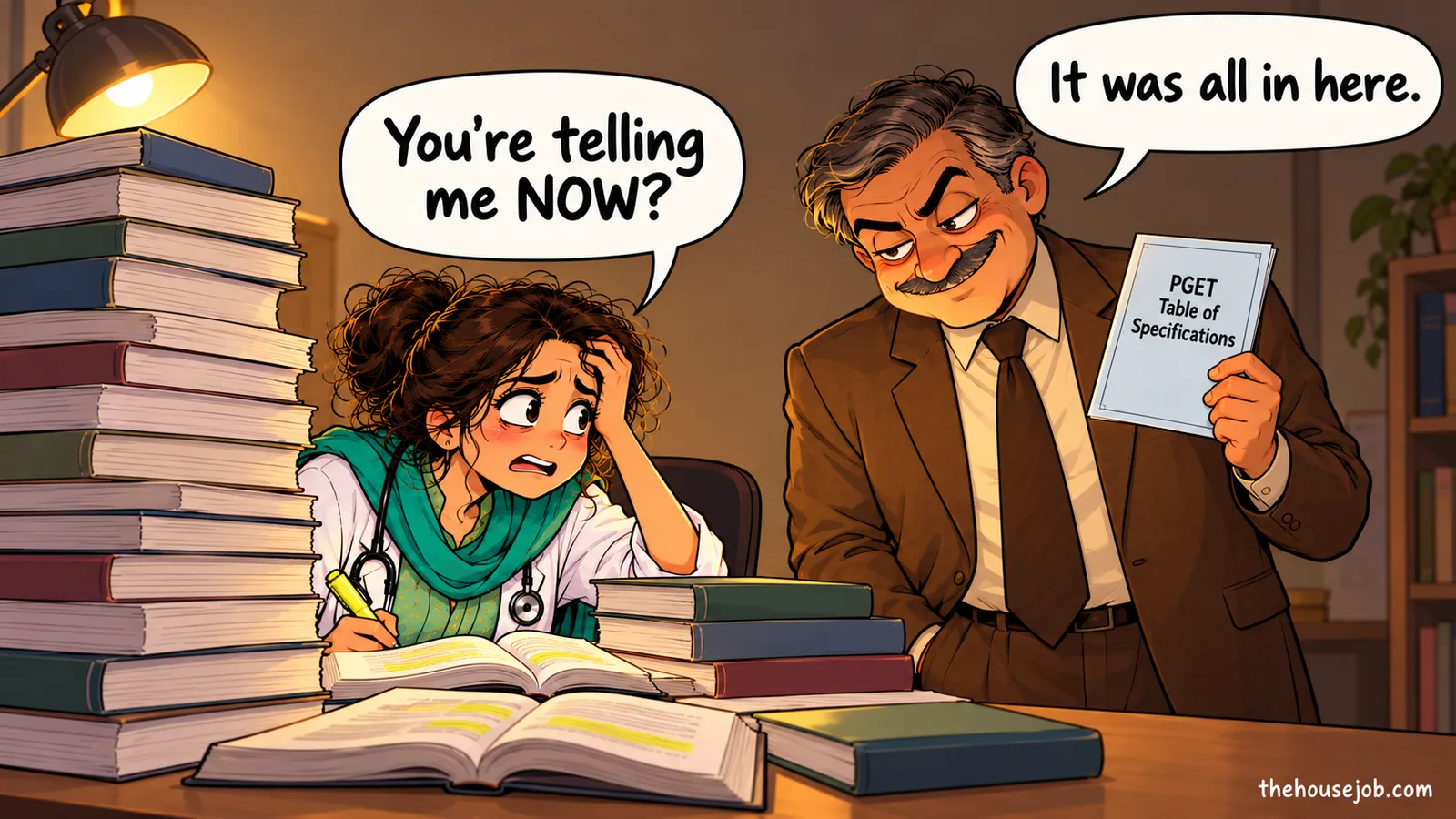 We went through 100 recalled PGET 2026 Paper I questions subject by subject. The paper followed the UHS table of specifications to the question, the questions were one-step, and Community Medicine was mostly statistics, research and ethics.


House job
What the house job is really like, and how to get through it well.
- PMDC says it has cleared 99% of applications. What to do if yours is still stuckPMDC says it issued 302,587 of 304,819 applications up to October 2026. Here is the breakdown, what to do if your licence is stuck, and why the renewal notice matters.
- The PMA strike is over for now. What it means for house officers, and what happens on 28 NovemberOPDs closed on 1 and 2 November over FIRs against doctors and FBR's point-of-sale rules. Here is what the strike was about, why FIRs matter to house officers, and the next date to watch.
- The house job survival guideThe year is long, the hours are brutal and the system won't look after you. Here is what actually helps you get through it, learn a lot and leave in one piece.
- Your first week as a house officerWeek one isn't about impressing anyone with medicine. It's about learning where things are, who decides what, and how to keep your patient list under control.
- Surviving night dutyNights are where house officers grow fastest and make the most mistakes. Prioritise the sick, see before you prescribe, escalate early and feed yourself.
- Dealing with attendants and familiesMost attendants are scared, not hostile. Explain clearly and often, never promise what you can't control, and know when to walk away and call for help.
- Medico-legal cases (MLCs) for house officersTrauma, burns, poisoning, assault, firearm injuries and deaths in suspicious circumstances are MLCs. Treat first, document precisely, and let the MLO handle the legal report.
- What is a house job? Meaning, rules and what comes afterA house job is the one-year supervised training every MBBS and BDS graduate in Pakistan must finish before full PMDC registration. Here is what it means, how it is structured, and why it matters for FCPS and your career.
- Burnout in the house jobExhaustion, cynicism and feeling useless aren't weakness. They are the predictable result of the job. Notice them early and get support.
- How to present a patient on ward roundsWho, why they came, what you found, what you think, and what you've done. One minute, no filler.
- How to get a house job in PakistanApplications open through provincial or hospital portals after final-year results. Merit, documents and timing matter. Choose a hospital for training and workload, not only the name.
- Writing notes and discharge summariesWrite so the next doctor can act without asking you. Date, time, findings, plan, your name. Discharge summaries need diagnosis, drugs, follow-up and red flags in plain language.
- Medicine and surgery rotations: what to expectMedicine is about thinking, follow-up and long lists. Surgery is about speed, pre- and post-op care and theatre time. Both reward the house officer who keeps the list tight.
- Breaking bad news and dealing with deathMost house officers face this early. Here are practical principles that help when there is little formal training.
- Common house job mistakes that juniors later regretMost of the painful lessons are the same across hospitals. Here are the ones that keep coming up when people look back on the year.
- Dealing with difficult seniors and ward politicsSome seniors are excellent. Others are hard to work with. Here is how to stay professional, protect patients, and protect your own mental health.
- First independent on-call as a house officerThe first nights when you are the first doctor the nurses call. Practical preparation, the common calls, when to escalate and how to recover.
- How to choose rotations if you are planning FCPSYou still have to do the required blocks. Within that, the order and the allied choices can make the year either more useful for your planned specialty or simply more survivable.
- Medicine ward survival tipsMedicine units are usually the heaviest. Here is a practical way to stay organised, answer the common calls, and finish the rotation in one piece.
- Private vs public house job in PakistanThe daily experience, learning, workload and pay differ more than the official descriptions suggest. Here is a practical comparison, and the PMDC rules that apply to both.
- Proper handover and notes in the house jobClear handover and readable notes are two of the simplest ways to look reliable and to keep patients safe when shifts change.
- Surgery ward survival tipsSurgery mixes ward work, theatre and post-operative care. Here is how to stay organised, prepare patients properly and learn without burning out.
NRE (National Registration Exam)
Everything about the PMDC NRE: format, eligibility, syllabus and how to prepare.
- NRE exam 2026: dates, registration and feeThe NRE Step 1 date for the second 2026 cycle is Sunday 8 November 2026, moved from 11 October. Full 2026 schedule, registration, fee and pass mark.
- NRE Step 1 is on 8 November. Here is what to do with the last 8 daysNRE Step 1 is on Sunday 8 November 2026. A day-by-day plan for the last 8 days built around one timed mock paper a day, plus what to check about your admit card and centre.
- NRE Step 1: the complete guideThe National Registration Examination is the PM&DC exam foreign medical graduates must pass to register and work in Pakistan. Step 1 is a 200-MCQ theory paper; Step 2 is a 20-station OSCE.
- NRE Step 2 has new dates, and registration opens on 23 November. You have ten daysPMDC has moved NRE Step 2 to three sittings between 12 December 2026 and 3 January 2027. Registration is open from 23 November to 2 December. Here is what changed and what to do this week.
- NRE Step 2 in November 2026: the dates still stand, but there is no registration notice yetPMDC's 2026 schedule still lists NRE Step 2 on 28–29 November and 5–6 December. As of 13 November, PMDC has not posted a registration notice for this session. Here is what that means and what to do now.
- NLE in Pakistan: is the licensing exam back?PMDC's president said in July 2025 that the National Licensing Exam would return for all MBBS and BDS graduates. As of 30 October 2026 there is no NLE date, fee or syllabus. Here is what we know.
- NRE Step 1 syllabus and high-yield topicsMedicine and surgery make up half the paper. Here's how PMDC splits the 200 MCQs and the topics that come up again and again.
- Think your NRE Step 1 marks are wrong? PMDC's re-totalling deadline is 25 NovemberPMDC will re-total NRE Step 1 marks for the 8 November exam. Apply on paper by 25 November with a Rs 1,200 pay order. Here is how, and what re-totalling can and cannot do.
- A 12-week NRE Step 1 study planTwelve weeks, one subject block at a time, with timed questions from week one and two full mocks at the end. Plus a six-week version if you are short on time.
- NRE Step 2: the Clinical Skills Examination20 OSCE stations, 8 minutes each, covering history, examination, procedures, counselling and management. Practise out loud, with a timer and a partner.
- Best resources for NRE preparationOne good question bank, one concise text per big subject, and local practice. More resources don't mean more marks.
- NRE Step 1 high-yield subjectsMedicine and surgery are half the paper and pathology is the biggest basic science. Here is where the marks are and how to spend limited time.
- NRE Step 1 vs Step 2: key differencesOne is a 200-MCQ theory paper, the other a 20-station OSCE. Here is how they differ and how to plan the gap between them.
- NRE Step 1 while working or after an internship abroadMany foreign graduates prepare for NRE Step 1 alongside a job, an internship abroad or family duties. Here is a realistic way to do it.
FCPS Part 1
CPSP FCPS Part 1: format, eligibility, study plans, high-yield topics by subject and past-paper analysis.
- FCPS Part 1 schedule 2027: exam dates and last date to applyFCPS Part 1 is held four times in 2027: 5 January, 6 April, 6 July and 5 October. Applications for January closed on 13 November 2026. The next one you can apply for is April 2027. Dates, fees and how to apply.
- FCPS Part 1: the complete guideFCPS Part 1 is the CPSP entry exam for specialist training in Pakistan: two computer-based papers of 100 single-best-answer MCQs, held four times a year at CPSP centres.
- What PGET 2026 Paper I actually testedWe went through 100 recalled PGET 2026 Paper I questions subject by subject. The paper followed the UHS table of specifications to the question, the questions were one-step, and Community Medicine was mostly statistics, research and ethics.
- FCPS Part 1 study planFour months, two subjects at a time, past-paper-style questions every day and full papers in the last month. It works even with a full house job.
- PGET 2026 rechecking closed on 4 November. What happens now?PGET 2026 rechecking, officially a recount, closed on 4 November. When applicants should hear back, what the manual check covers, and whether it can turn a fail into a pass.
- Best books for FCPS Part 1One standard text per subject for understanding, past-paper-style questions for practice, and a mistakes notebook for revision.
- IMM dates 2027: CPSP Intermediate Module exam scheduleThe CPSP Intermediate Module (IMM) theory exam is on 16 February and 17 August 2027. Who sits it, how it is examined, when to apply, and why it matters for keeping your FCPS Part 1 valid.
- You passed FCPS Part 1. Punjab just decided it doesn't count.Three in four doctors failed UHS PGET 2026, including doctors who had just passed FCPS Part 1. This is not a story about weak candidates. It is a story about a formula, and about the people it was always going to fail.
- Why 3 in 4 doctors failed PGET: the 75th percentile trap, explainedWhat "75th percentile" really means, why your PGET result shows no marks, how the January 2027 merit formula is calculated, where FCPS Part 1 now stands, and what score you need next time.
- PGET 2027: what to study, and how to finish in the top 25%The next PGET is expected in spring 2027. Here is where the 100 Paper I marks come from, the one block FCPS Part 1 does not cover, and a 12-week plan built around finishing in the top quarter.
- How to choose an FCPS Part 1 question bankA question bank is where most of your marks are made, so choose it on what it teaches, not how many questions it claims. Here are the checks to run before you pay for any of them.
- Acid-base and ABGs for FCPS Part 1: a method that works every timeEvery acid-base question can be solved with the same four steps. Here is the method, the anion gap, the compensation rules and worked gases from the ward situations that examiners copy.
- Behavioural sciences and ethics for FCPS Part 1Behavioural science questions are scenario questions. Name the principle, the defence mechanism or the learning type in the story, and most of them answer themselves.
- Biostatistics for FCPS Part 1 and NRE: the marks you should never loseBiostatistics is the most reliable scoring area in the paper. The same handful of calculations and definitions are asked again and again. Learn the 2 × 2 table and a few formulas and these marks are yours.
- FCPS Part 1 biochemistry: the high-yield guideBiochemistry questions reward a small set of facts asked again and again: rate-limiting enzymes, vitamin cofactors, inborn errors and a handful of lab techniques. Learn those as pairs.
- FCPS Part 1 embryology: the high-yield guideEmbryology questions ask two things: what came from what, and what goes wrong when something fails. Learn it as cause and effect and it becomes the quickest marks in anatomy.
- FCPS Part 1 haematology: the high-yield guideHaematology questions reward a few sorting tools: the MCV, the reticulocyte count, PT and APTT, and a short list of translocations. Here is each one with the stories examiners use.
- FCPS Part 1 histology: the high-yield guideHistology questions ask you to match a tissue to its lining, its special cells or its one distinguishing feature. Learn the distinguishing features, not every layer.
- FCPS Part 1 microbiology: the high-yield guideMicrobiology questions are pairing questions: a clue in the stem points to one organism, one toxin or one lab test. Learn the pairs and the sorting rules, not long lists.
- Neuroanatomy that keeps appearing in FCPS Part 1Neuroanatomy questions are lesion questions: here is the deficit, where is the damage? Learn the tracts, the cord syndromes and the stroke patterns, and most questions answer themselves.
- Upper and lower limb anatomy for FCPS Part 1Limb anatomy questions are injury questions. A fracture, a cut or a dislocation damages a nerve, and you are asked what the patient cannot do or feel.
- Cardiovascular physiology for FCPS Part 1Cardiovascular physiology questions come from a short list: the cardiac cycle, action potentials, pressures and volumes, Starling's law, and how blood pressure is controlled. Master the graphs and the numbers.
- Endocrine physiology for FCPS Part 1Endocrine questions test feedback loops, where each hormone comes from, how it signals and what its excess or deficiency looks like. Learn each axis as a loop.
- Head and neck anatomy for FCPS Part 1Head and neck questions centre on cranial nerves, the neck triangles, the thyroid and parotid, the larynx and a few classic surgical injuries. Learn the relations, not just the lists.
- Renal physiology for FCPS Part 1Renal physiology questions test where each substance is handled along the nephron, how GFR is controlled and measured, and how the kidney concentrates urine. Learn the nephron segment by segment.
- FCPS Part 1 Paper 2 for Medicine & Allied: what to studyPaper 2 for the medicine group applies the basic sciences to medical patients: systemic physiology, regional anatomy, immunology, infection, neoplasia and the drugs physicians use every day.
- FCPS Part 1 Paper 2 for Surgery & Allied: what to studyPaper 2 for the surgery group takes Paper 1 science and applies it to surgical patients: regional anatomy, fluids, wound healing, surgical pathology, oncology and the drugs surgeons use.
- FCPS Part 1 Paper 2 for Obstetrics & Gynaecology: what to studyPaper 2 for Obstetrics & Gynaecology applies the basic sciences to women and pregnancy: the pelvis, reproductive physiology, drugs in pregnancy and the pathology of the female genital tract.
- Common FCPS Part 1 preparation mistakesMost failed attempts share a small set of avoidable patterns. Here they are, and what to do instead.
- FCPS Part 1 Paper 2 for Diagnostic Radiology: what to studyPaper 2 for Diagnostic Radiology tests specialty-related basic sciences: anatomy (the largest part, including embryology and cross-sectional anatomy), physiology by system and pathology, asked mostly as plain applied questions.
- FCPS Part 1 after one failureFailing once is common. The second attempt is about honest diagnosis and a tighter method, not just more hours of the same approach.
- FCPS Part 1 anatomy: high-yield focusAnatomy is large but prioritised, clinically linked knowledge scores better than trying to memorise every detail equally.
- FCPS Part 1 exam day: logistics and mindsetMost exam-day stress is avoidable. Sort the admit card, the travel and the hall rules early, then pace the paper calmly.
- FCPS Part 1 pathology: high-yield topicsPathology links mechanisms to disease. Here is a practical high-yield focus, the facts that keep coming back, and a study method that retains better than passive reading.
- FCPS Part 1 pharmacology: high-yield topicsPharmacology in Part 1 rewards prioritised lists and mechanism-based understanding more than exhaustive textbook reading.
- FCPS Part 1 physiology: high-yield topicsPhysiology is one of the subjects that most often decides the result. Here is a practical high-yield focus, the facts that keep repeating, and a study method.
- FCPS Part 1 with a weak MBBS foundationUneven basics are common. The path is honest diagnosis of gaps and protected time to rebuild them, not pretending the gaps are not there.
- FCPS Part 1: medicine vs surgery groupPaper 1 is the same for both groups. Paper 2, the specialties it opens and the competition for seats are what differ. Here is how to think about the choice.
- FCPS Part 1: the last 30 daysThe final month is for consolidation and timed practice, not new books. Here is a week-by-week plan and the mistakes that cost people marks.
- FCPS training seats: realistic chancesPassing Part 1 is necessary but not enough. From January 2027, Punjab also wants a PGET pass. Here is how seats are really decided and how to improve your chances.
- How many hours per day for FCPS Part 1?Focused hours matter more than total time near books. Here are realistic ranges, sample days for full-time and working candidates, and what makes an hour actually count.
- How to analyse FCPS Part 1 past papersSolving papers is not enough. Analysing every wrong and guessed answer is what turns practice into score improvement.
- Studying for FCPS Part 1 during house jobAlmost everyone plans to study for Part 1 during the house job year. Here is what the people who actually made progress did differently.
Careers after MBBS
Postgraduate options in Pakistan and abroad: FCPS, UK, Ireland, Canada, Australia, New Zealand and the Gulf.
- Career options after MBBS in PakistanAfter the house job you can train for FCPS or a university MS/MD, aim for the UK, US, Ireland, Australia, Canada or the Gulf, or move into public health, research or non-clinical work.
- Australia medical registration for Pakistani doctorsThe main steps through the AMC Standard pathway and Ahpra registration, the English scores that changed on 23 April 2026, and an honest picture of how long it takes.
- Canada PR for Pakistani doctors via Express EntryA practical walk-through of the Express Entry route many Pakistani doctors use: language test, MCC ECA, proper reference letters, upfront medical, profile creation and the healthcare and physician draws.
- FCPS first or abroad first?A practical way to decide based on where you actually want to live and work in seven to ten years, not on prestige or what your batchmates are doing.
- FCPS vs MRCP vs USMLE: which path?Three exams for three different destinations. A practical way to decide which one fits the life you actually want, with what each exam really gets you.
- Gulf registration for Pakistani doctors (UAE and Saudi)What the DHA and SCFHS processes actually require, how much experience is needed, and the steps that usually take the longest.
- Gulf salary and contract realitiesBasic salary is only one number. Housing, flights, hours, end-of-service and the basic-to-allowance split decide whether a Gulf package is actually good.
- Ireland medical registration for Pakistani doctorsA Pakistani house job that started in 2009 or later can count as equivalent to an Irish internship, so many of us can register without the PRES. Here is how it works, where applications get stuck and what is changing in 2026.
- MBBS to specialist in Pakistan: realistic timelineThe path is longer than most people expect when they graduate. Here are the stages from house job to FCPS fellow, how long each takes, and what usually stretches them.
- New Zealand medical registration for Pakistani doctorsHow Pakistani graduates get registered in New Zealand: NZREX Clinical, or PLAB or AMC exams passed in the last five years, then a PGY1 job and two years of prevocational training.
- UK PLAB and GMC registration for Pakistani doctorsThe realistic sequence from house job in Pakistan to a GMC licence: English test, PLAB 1, PLAB 2, internship evidence, fees and the documents that actually get checked.
- UK pathway cost and timeline for Pakistani doctorsHow long the PLAB/GMC route really takes and where the money actually goes, from the IELTS fee in rupees to the months in the UK around PLAB 2.